
Hypermobility & Fatigue after Exercise: Tips from a Physio
Fatigue is common in hypermobile disorders (HSD/hEDS) – often with pain & flare ups. Learning gentle, sustainable exercise skills can make movement feel more manageable.

last updated: 15 July 2026

Fatigue after exercise is common in hypermobility disorders (HSD/hEDS), with pain, joint instability and flare‑ups making movement feel unpredictable and sometimes scary.
With fatigue-aware strategies, pacing & stabilisation work, you can build confidence and make activity feel more manageable.
Fatigue. Being tired. Exhausted. Crashed. Wiped out. These words don’t convey the heaviness of managing fatigue on a day-to-day basis. I’ve managed fatigue since my teens, and supported clients struggling with it – it can affect all aspects of life from education, to employment, relationships and well-being. While there isn’t a quick fix for hypermobility fatigue or exercise intolerance, the right strategies can help reduce the frequency and length of flare‑ups. Feeling more stable, mobile and stronger makes everyday activities more manageable and brings long‑term health benefits.
I believe passionately that everyone should have access to safe, adapted exercise with the right accommodations, pacing and modifications — all while staying within their energy envelope. Hopefully some of the ideas here help you find your balance.

Disclaimer: This information is for general education only & isn’t a substitute for personalised medical advice, assessment or diagnosis. Symptoms like pain, fatigue & instability can have many possible causes, so it’s important to discuss any new, changing or concerning symptoms with a qualified healthcare professional.
Hypermobility disorders/syndromes include hypermobile Ehlers Danlos (hEDS) and hypermobility spectrum disorder (HSD) and are connective tissue disorders resulting in the increased elasticity of connective tissues. This causes subluxations/dislocations and often, chronic pain. Fatigue is extremely common – a 2016 survey found that 80% of people with hEDS report fatigue. These symptoms make exercise feel unpredictable, which can lead to exercise anxiety, fear of flares, fear of injury or feeling unsure where to start.
Hypermobility isn’t “just being flexible.” It can affect strength, proprioception, and confidence in movement or exercise which can cause lower levels of physical activity and deconditioning, as outlined in this 2026 clinical trial[2] in the Journal of Multidisciplinary Healthcare. A gentle, structured approach to getting started can help you feel safer and make exercise feel more sustainable.
If you’re still getting to grips with what hEDS or HSD actually mean for your joints, energy systems and day‑to‑day symptoms, you might find my guide on hypermobility disorders helpful before you go any further. This gives readers foundational understanding before tackling fatigue.
The NHS, the Hypermobility Syndromes Association and the Ehler Danlos-Society also have more information.
Fatigue can show up in different ways with HSD/hEDS:
Some common causes for fatigue in hEDS include poor sleep quality, chronic pain, physical deconditioning, orthostatic intolerance, cardiovascular dysregulation, changed bladder and bowel function and mood.
Fatigue specifically after activity/exercise in hypermobility disorders could be caused by a number of factors:
Learning and developing strategies that work for your body can help reduce fatigue, and the impact of reduced levels of physical activity. Physiotherapy can form one pillar of care in managing fatigue, along with support from other relevant healthcare professionals such as GPs, OT, psychology, dietetics and any other indicated specialisms.
If you’re unsure which types of exercise actually feel manageable with unstable joints, my guide on the best types of exercise for hypermobile people explains which movements support stability without overwhelming your energy.
This is important…
Flare ups are not always a consequence of over‑doing it – someone can have paced perfectly, but something happens (illness, hormones, external event, seasonal change) which aggravates a flare‑up. And sometimes, they can be totally random.
This means that without a crystal ball to tell the future, it is really difficult to manage effectively. I see a lot of clients (and sometimes catch myself) tying themselves in knots trying to figure out ‘what they did wrong’ and putting the blame on themselves.
It’s not always something you did. Be kind to yourself in that moment.
RELATED ARTICLE → Chronic Pain & Movement Avoidance: How Can I Exercise Safely?
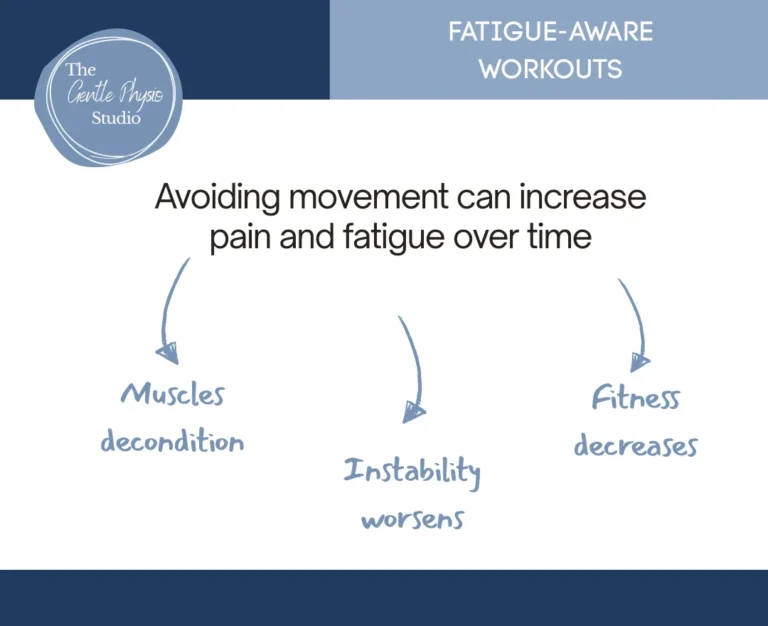
Short answer: no — avoiding movement often increases fatigue, pain and instability over time as muscles decondition and fitness decreases. But it does mean you need fatigue‑aware exercise, not generic workouts.
People with hypermobility often feel scared, overwhelmed and afraid to move. They are unsure about where to start and are worried about making things worse. If you’ve had flare‑ups after trying to exercise in the past, these worries are understandable and logical.
Fatigue and hypermobility disorders change the goal posts. Its not about ‘pushing through’ and I’ve banned the phrase ‘no pain, no gain’ from my clinic. It means you need to learn to read the signals your body gives you and use that information to help you work within a safe capacity. Some people talk about how many spoons they have left, others talk about their energy envelope or batteries.
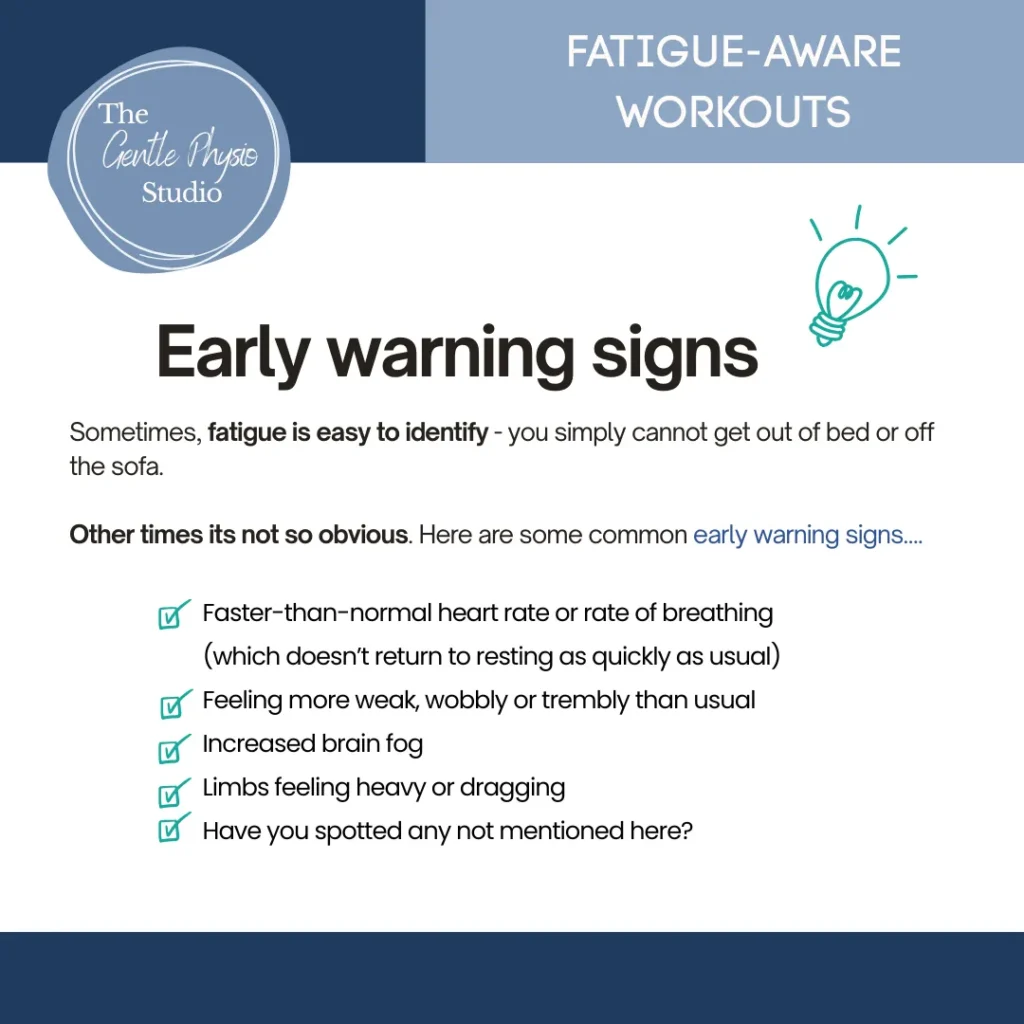
Sometimes, its incredibly obvious you are fatigued – you may struggle to get off the sofa, your limbs may feel weak and wobbly, you might have brain fog and impaired thinking. Other times, its not so obvious and it creeps up on you before you realise you are doing more than you can manage. Those are the times that keeping to a consistent structure and carefully planning progressions are really valuable, because it means you don’t suddenly hugely increase what you are doing.
If fear of pain or flare‑ups has made movement feel overwhelming, I’ve written a guide on chronic pain and movement avoidance that can help you rebuild confidence with exercise at your own pace.
RELATED ARTICLE → Hypermobility & Fatigue after Exercise: Tips from a Physio
An important part of developing a fatigue-aware approach involves noticing early signs so you can adapt to where your body is that day. There is less research on the specific of this, but in my clinic and personal experience, some warning signs can include:
Movement becomes safer and more sustainable when it’s paced, stabilised and tailored to your symptoms. The better you get at understanding your body’s signals, the more confidence you can have in choosing what will work for you each day.
Sometimes, a flare-up will mean that modifications are necessary, and sometimes, it’ll mean it’s a sofa day – and you’ll be in control of making that choice.
Preparing for exercise isn’t just about warming up your joints – it’s about reducing the energy cost, decision load and unpredictability that make movement harder. Here are some strategies which may help:
These strategies can help reduce the risk of asking too much of your body in one day or week:
This helps reduce the risk of asking too much of your body in one day or week.
Make it easier by:
Lowering the setup cost makes it far more likely you be able to start.
Instead of reinventing the wheel, use a simple, repeatable structure. In its simplest form, this means warm up, main exercise, cool down. I normally start with just 2 exercises in each section, and only 2–3 reps.
Eventually, many can build up to a 30–45 minute session, which includes rests and discussion time. It might include 3–4 warm‑up exercises, 6 main exercises, and 3–4 cool‑down exercises — but this can take several months (or longer) to reach, as flare‑ups need to be accommodated.
If you are in flare‑up, but it’s not quite a sofa day, doing some movement to help maintain your baseline fitness can be helpful. It might be that you:
Sometimes, people have a really good idea about what caused a flare, and other times they don’t – but it’s worth bearing in mind that it may not have been the exercise.
DON’T FORGET – 1) Fatigue can be delayed, sometimes up to two days or even longer, so you need to assess over that time period. 2) You could flare‑up and it not be related to the exercise, but something else entirely. 3) Flare‑ups can be random. No cause at all. Nothing you did wrong – just the product of complex, chronic health conditions.
External structure can help – and so can other ADHD executive dysfunction management tools.
The idea is using whatever technique helps YOU reduce avoidance/forgetting/PDA – and that’s different for everyone, so don’t feel worried if something doesn’t seem to work for you. When you have the energy, change it up or try something new.
RELATED ARTICLE → Chronic Pain & Movement Avoidance: How Can I Exercise Safely?
Certain types of lower exertion exercises are sustainable – modified Clinical Pilates, walking – but most types of exercise can be adapted to be more fatigue-friendly. Techniques like the ones below can help reduce exercise intolerance, pain flare-ups, joint instability and fatigue.
If you’d like more structured physiotherapy ideas for building stability before adding load, my guide on safe strength training with hEDS/HSD shares practical ways to strengthen without triggering fatigue or flare‑ups.
You don’t need to do the full movement. Just do the bit which feels safe and stable – and build from there. Start with tiny weights. Start with short holds (none of this two minute plank business!). Start with the lightest resistance band.
Start with small stable movements
Absolutely every workout I create (and do myself) has rest breaks built in. This is not optional, even high level athletes use rest to help them achieve more over a workout than if they worked at high exertion continuously. Generally 30-90 seconds of rest works, depending on the person. In sessions, I often work with a heart rate monitor to help people find the pattern that works for them.
Use structured rest to reduce energy demand
If your trunk, pelvis & shoulders aren’t strong, stable and well coordinated, doing exercises using your arms and legs and weight becomes much more difficult. Working on foundation exercises (eg. starter pilates exercises like bridge series and 4 point kneeling exercises) is an excellent idea.
Prioritise stability before adding load
This helps you keep it consistent, but also means you don’t waste energy trying to remember – or plan – your workout.
Track your workouts to stay consistent
Managing a chronic condition (and often more than one) is really hard. If you can’t manage what you had planned, that is OK – take a breath, do a shoulder roll or two (within comfortable range) and give yourself a hug (avoiding shoulder dislocations please!)
Be kind to yourself on low capacity days
Recovery is where many people with hEDS/HSD struggle – especially if they experience post‑exercise fatigue, delayed fatigue or PEM‑like symptoms.
Things to try include:
Remember: recovery isn’t about doing more – it’s about doing what helps your system settle back to a more relaxed, less stimulated state.

A specialist physiotherapist can help when you’re experiencing flare-ups of pain or fatigue after activity or exercise, or you would like to start exercising but are worried about injury or overdoing it.
A physio trained in hEDS/HSD can build a personalised plan using fatigue‑aware exercise, stabilisation work, pacing strategies and joint‑specific rehab — all tailored to your symptoms and goals.

Fatigue is common in hypermobile disorders (HSD/hEDS) – often with pain & flare ups. Learning gentle, sustainable exercise skills can make movement feel more manageable.

Strength training can feel overwhelming with hEDS or HSD — especially with pain, fatigue or fear of flare ups. This guide shares safe, stabilisation focused physiotherapy ideas to help you build strength confidently, reduce injury risk and stay within your energy envelope.

Finding the right exercises with hEDS or HSD can feel overwhelming when pain, fatigue or joint instability get in the way. This guide explores some of the best types of exercise for people with hypermobility disorders — and explains how each one supports stability, confidence and day to day function without overwhelming your energy.
Hollie is a UK Physiotherapist specialising in hypermobility disorders, chronic pain, fatigue, autonomic symptoms and neurodivergence‑informed rehab. She works remotely across the UK, offering calm, paced physiotherapy for people whose symptoms fluctuate day‑to‑day.
Her approach blends clinical training with lived experience of hEDS, chronic pain, fatigue, instability and endometriosis, giving her a deep understanding of boom‑and‑bust cycles, flare‑ups and the fear of making symptoms worse.
Hollie has spent 15 years teaching movement (Clinical Pilates, Therapeutic Yoga, Shaw Method swimming and Aquatic Therapy), helping people rebuild confidence in movement.
You can learn more about her background and clinical approach on the About Me page.

If you’d like personalised guidance, I offer gentle, supportive physiotherapy for hypermobility, fatigue and flare‑safe exercise — online across the UK. Here are some next steps:
If you are ready to get started, you can book a remote initial assessment with me – a 45 minute session designed to understand your symptoms, your goals, and how we can get there.
Introductory offer: £26 £45
If you’d like to get a sense of who I am and how I work, you can read more about my background, my approach, and the values that shape every session. I support people with chronic pain, fatigue and hypermobility using a calm, paced, and collaborative style – so you always know what to expect.
If you’d like to see what this work can look like in real life, you can read the stories of people I’ve supported. I’m incredibly proud of what they’ve achieved, not because of big dramatic changes, but because of the steady, brave steps they’ve taken in their own bodies.