

Hypermobility & Fatigue after Exercise: Tips from a Physio
Fatigue is common in hypermobile disorders (HSD/hEDS) – often with pain & flare ups. Learning gentle, sustainable exercise skills can make movement feel more manageable.

last updated: 15 July 2026

Struggling to exercise or finding that movement feels scary with hEDS/HSD, fibromyalgia or other chronic pain conditions?
This guide explains why movement can feel unsafe, how avoidance develops, and gentle ways to rebuild confidence so you can move more comfortably and predictably.
I’ve lived with my own mix of chronic pain, fatigue and unpredictable flare‑ups, and I know how quickly movement can shift from feeling absolutely fine to causing pain or other problems. For years I avoided certain movements because I wasn’t sure what my body would do, or how big the payback might be. That lived experience shapes how I work as a physio – with clarity, gentleness and a deep respect for how frightening it can feel when your body stops behaving predictably.

Disclaimer: This information is for general education only & isn’t a substitute for personalised medical advice, assessment or diagnosis. Symptoms like pain, fatigue & instability can have many possible causes, so it’s important to discuss any new, changing or concerning symptoms with a qualified healthcare professional.
This isn’t just a list of exercises you “should” be doing. It’s a framework for understanding why movement can feel difficult, and how to explore it safely without triggering flare‑ups.
Take what feels useful, leave what doesn’t, and move through it in whatever order works for your brain and your body.
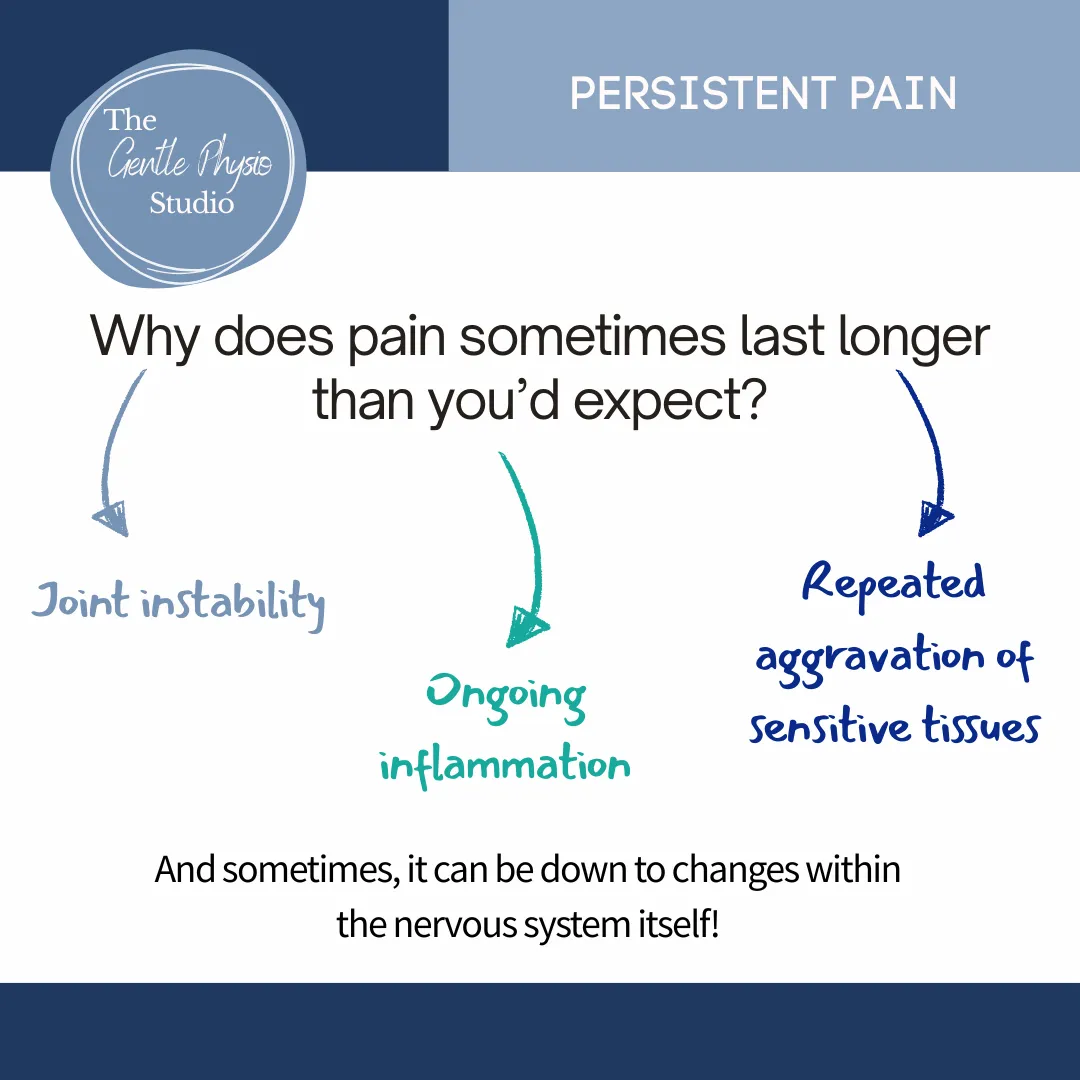
Chronic pain is common in conditions like hEDS/HSD, fibromyalgia, ME/CFS and other long‑term pain disorders. It’s defined as pain lasting longer than three months, and it doesn’t always map neatly onto tissue damage. Pain can persist for many reasons, including:
One of the most important concepts here is central sensitisation: a process where the brain and spinal cord become more responsive to sensory input, amplifying pain signals. This doesn’t mean the pain is “in your head” – it means the nervous system has become more protective, which is common in chronic, multisystem conditions.
You can also read more about hypermobility and pain in my guide on hEDS/HSD basics, which helps make sense of hypermobility disorders.
RELATED ARTICLE → Chronic Pain & Movement Avoidance: How Can I Exercise Safely?

A helpful example…
Imagine putting a healthy finger in a brace and not moving it for a day. It would feel odd when you finally bent it. Now imagine a month… or six months. It would be thinner, weaker, less coordinated, and movement would likely be painful – even though it wasn’t originally.
This is why it’s so important to explore whether movement avoidance is contributing to someone’s symptoms, and to support them in managing it safely and effectively.
Movement Avoidance is exactly what it sounds like: avoiding a movement or activity. Most research on chronic pain focuses on people avoiding movements because they’re afraid of pain, but in clinic I see that any destabilising symptom can lead to avoidance, including:
This means that when assessing movement patterns, its really important to look at the whole picture.
Avoiding movements that do cause pain or other distressing symptoms is a normal, protective response, and a positive adaptation in the short term. Pain or discomfort is a powerful educator – the body uses it to keep you safe while tissues heal or to prevent further injury.
However, if movement avoidance continues after tissues have healed, or spreads to movements that aren’t actually harmful, it can cause problems. Joints are designed to move, and movement keeps them healthy. When joints don’t access their full range for a long time:
RELATED ARTICLE → Hypermobility & Fatigue after Exercise: Tips from a Physio
Sometimes Movement Avoidance spreads to previously comfortable movements, a pattern known as generalisation and highlighted in studies of chronic pain and multisystem conditions.
A 2022 interview study by André & Lundberg describes how people with persistent pain often lose confidence in their bodies and begin avoiding whole categories of movement, not just the painful ones. Participants talked about feeling unsure how to move safely and trying to “find the right way to move” because their symptoms felt unpredictable.
The Meulders review makes a similar point: when pain is inconsistent or multisystemic, the nervous system naturally becomes more protective, and avoidance can spread even to movements that were previously comfortable.
When avoidance generalises, it can:
This widening pattern of avoidance is common in chronic, fluctuating conditions – and understanding it is key to helping people rebuild confidence and capacity.
If you’re starting to notice these patterns in your own body, my article on safe strength training for hypermobility looks at ideas for exploring weight training in ways that feel safe and progressive.
I’m not a huge fan of this definition, but it is widely used, so here it is: kinesiophobia is defined as an “excessive, irrational and debilitating fear of movement.” (Reference: Physio‑Pedia – Kinesiophobia)
A quick context check for the Tampa Scale of Kinesiophobia:
In these conditions, symptoms can be variable and unpredictable from day to day. Some areas are consistently painful, others only occasionally so, and sometimes small movements can trigger unexpectedly big reactions. Under these circumstances, I’d argue that fear of movement is far from irrational, though it can certainly be debilitating. And calling people irrational without assessing the symptoms they experience during movement is probably unhelpful.
Whether or not the fear of movement is “excessive” depends on:
1) the pain or symptom level experienced during movement
2) the person’s level of tolerance (which changes from day to day)
If fear extends to pain‑free movements, it can have the impacts we’ve already discussed. If it’s limited to painful movements, then it isn’t fear of movement – it’s fear of pain, which is a different thing to unravel.
RELATED ARTICLE → Chronic Pain & Movement Avoidance: How Can I Exercise Safely?

Fear of pain and fear of movement are not the same thing – and both can exist in the same person (and even the same movement) at the same time. Making this distinction helps us understand why avoidance developed and how to support someone in rebuilding confidence.
A helpful way to explore this is to:
This approach respects the reality of chronic pain while still helping people expand their capacity in a safe, supported way.
This is a huge (and really important) topic for chronic pain and hypermobility patients which I want to write a full article about soon so keep your eyes open for links to it on social media.
But for now, my tldr is: Yes, pain when moving is sometimes OK. Here are some strategies to try, but be warned, they are not hard and fast rules and sometimes breaking them is the right thing to do.
Is it OK to lift your arms halfway? Can you do half a squat? If not, how much can you bend your knee whilst sitting?
Only do short sessions and gradually build up.
It hurts, but at an OK level. This can change — some days a 6 might be tolerable, other days it could be a 3.
If it keeps hurting at an intolerable level for more than 10 minutes afterwards, it was probably too much.
Movement shouldn’t affect your ability to do daily activities for the rest of the day or the days after.
Follow Hollie and the Gentle Physio Studio for grounded guidance you can use every day
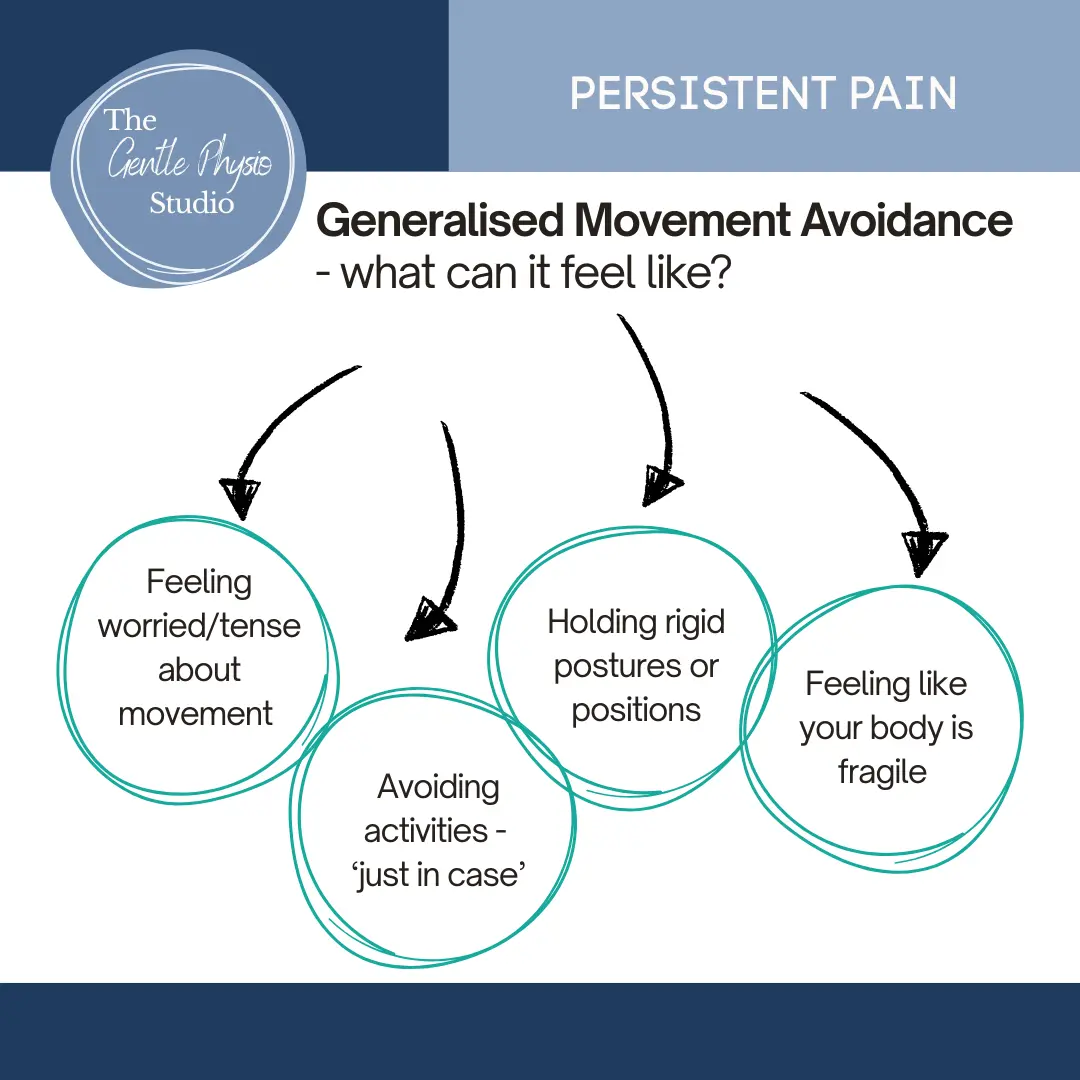
Generalised Movement Avoidance can show up in many ways. It might look like:
These experiences were also described in the André & Lundberg interviews, where participants talked about decreased confidence in their bodies and uncertainty about how to move without making things worse.
Exercise becomes difficult when you’re unsure which movements are safe, or when past flare‑ups have taught you to be cautious. Many people with chronic pain, hypermobility or fatigue conditions feel stuck between:
This is where the research is helpful: both the André & Lundberg study and the Meulders review emphasise that avoidance often develops because people haven’t been given clear explanations or safe ways to explore movement. Once people understand their symptoms and have support, confidence improves.
CO: The goal is not to push through pain or force yourself into movements that feel unsafe. Instead, it’s about gentle exploration – finding movements your body can do comfortably, and gradually building from there.
If fatigue is more impactful for you than pain, my guide on fatigue after exercise in hypermobility breaks down how to adapt and modify exercise habits so they match your capacity.
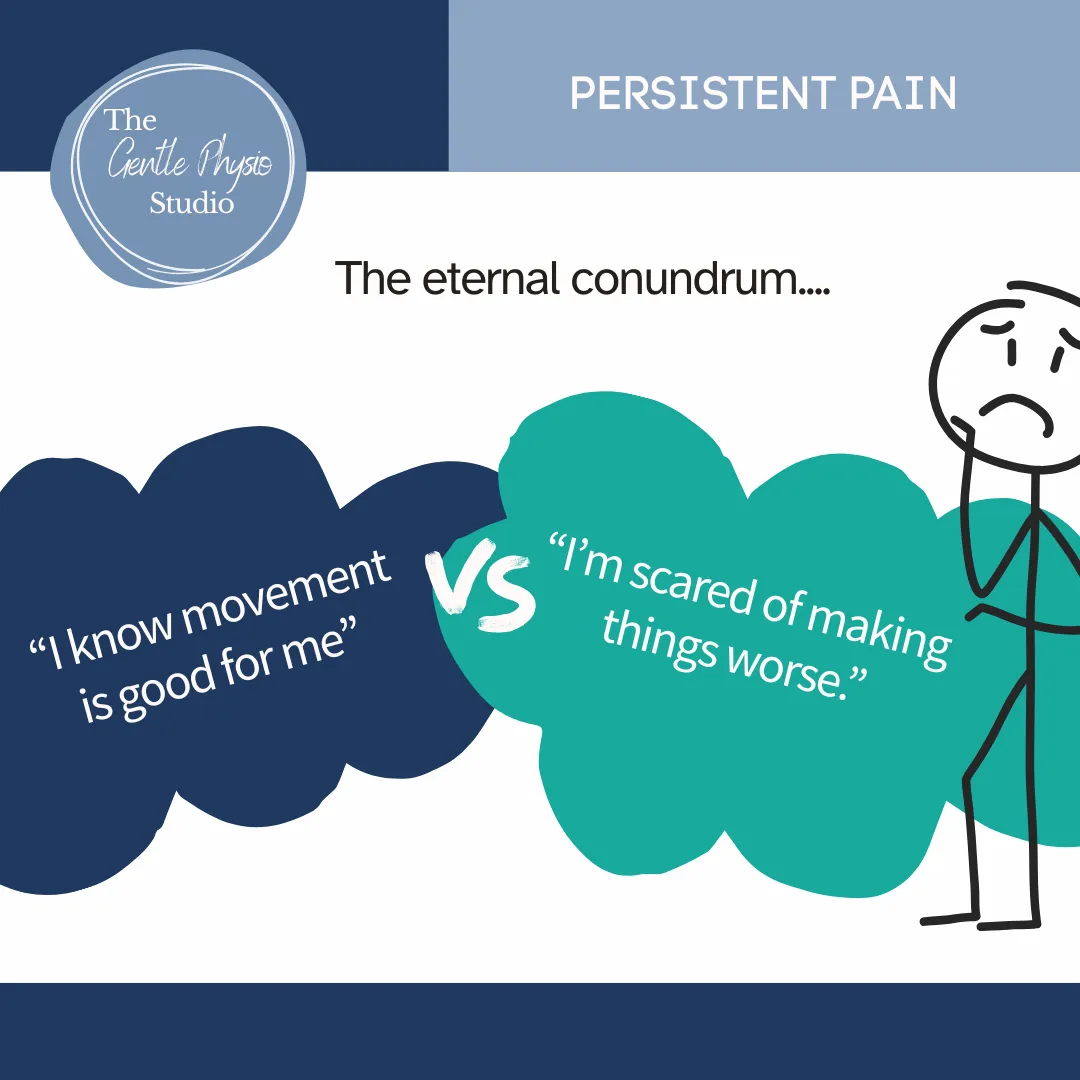
The goal here is not to push through pain or force yourself into movements that feel unsafe. Instead, it’s about gentle exploration – finding movements your body can do comfortably, and gradually building from there.
Be Kind To Yourself
Even simply recognising that you might be avoiding some movements based on fear rather than pain can be helpful. Exploring movement with gentle curiosity – “I’ll see what I can do without pain, (or without pain I can’t tolerate)” – helps you understand what your body can manage today.
With variable and unpredictable conditions, your experience can feel very different from one day to the next. Challenging your body’s assumptions and recalibrating to accurate, up‑to‑date information reduces the risk of avoiding movements unnecessarily. Below are some other research-backed tools you can try.
Chronic pain is a heavy burden, and low mood, anxiety or depression can affect motivation and confidence. Vandael et al. identified values-led goal setting as particularly helpful – identifying activities that matter to you and using them as anchors for progress. Some people benefit from talking therapies such as Acceptance and Commitment Therapy (ACT), but these principles can also be integrated into physiotherapy.
In clinic, helping people understand movement avoidance – and how to regain lost capacity – is often an important part of treatment.
Someone might be nervous about trying a mini squat because their knees feel painful or unstable. So we start with the smallest possible range – a micro‑bend, or even practising the movement in sitting. Often, people are surprised to find that the movement itself isn’t painful, which gives us confidence to explore a little further.
We’re not pushing into pain. We’re mapping out:
This helps us identify the range of movement that is genuinely comfortable, rather than the range the nervous system has learned to avoid. From there, we can build, stability, proprioception, confidence, strength, endurance & movement options… all at a pace that respects your symptoms, your energy, and your lived experience.
Fatigue is common in hypermobile disorders (HSD/hEDS) – often with pain & flare ups. Learning gentle, sustainable exercise skills can make movement feel more manageable.

Strength training can feel overwhelming with hEDS or HSD — especially with pain, fatigue or fear of flare ups. This guide shares safe, stabilisation focused physiotherapy ideas to help you build strength confidently, reduce injury risk and stay within your energy envelope.
Finding the right exercises with hEDS or HSD can feel overwhelming when pain, fatigue or joint instability get in the way. This guide explores some of the best types of exercise for people with hypermobility disorders — and explains how each one supports stability, confidence and day to day function without overwhelming your energy.
Hollie is a UK Physiotherapist specialising in hypermobility disorders, chronic pain, fatigue, autonomic symptoms and neurodivergence‑informed rehab. She works remotely across the UK, offering calm, paced physiotherapy for people whose symptoms fluctuate day‑to‑day.
Her approach blends clinical training with lived experience of hEDS, chronic pain, fatigue, instability and endometriosis, giving her a deep understanding of boom‑and‑bust cycles, flare‑ups and the fear of making symptoms worse.
Hollie has spent 15 years teaching movement (Clinical Pilates, Therapeutic Yoga, Shaw Method swimming and Aquatic Therapy), helping people rebuild confidence in movement.
You can learn more about her background and clinical approach on the About Me page.

If this guide resonated with you, you might like to find out more about how I support people with chronic pain, fatigue and hypermobility here are some useful next steps:
If you are ready to get started, you can book a remote initial assessment with me – a 45 minute session designed to understand your symptoms, your goals, and how we can get there.
Introductory offer: £26 £45
If you’d like to get a sense of who I am and how I work, you can read more about my background, my approach, and the values that shape every session. I support people with chronic pain, fatigue and hypermobility using a calm, paced, and collaborative style – so you always know what to expect.
If you’d like to see what this work can look like in real life, you can read the stories of people I’ve supported. I’m incredibly proud of what they’ve achieved, not because of big dramatic changes, but because of the steady, brave steps they’ve taken in their own bodies.